

Anal intraepithelial neoplasia
AIN; anal squamous intraepithelial lesion (anal SIL); AIN1 = LSIL; AIN2/3 = HSIL; perianal Bowen's disease
Anal intraepithelial neoplasia (AIN) is squamous intraepithelial dysplasia of the anal canal and perianal skin driven, in the great majority of cases, by high-risk human papillomavirus — most commonly HPV-16. The 2012 LAST consensus reclassified AIN1 as low-grade SIL (LSIL — usually transient HPV cytopathic effect) and AIN2/3 as high-grade SIL (HSIL — the true precursor of invasive anal SCC). The condition is markedly over-represented in HIV-positive men who have sex with men, in whom multifocal high-grade disease is the norm and progression to invasive anal SCC reaches ~1% per year. The 2022 ANCHOR trial demonstrated that treatment of HSIL in HIV-positive adults reduces invasive anal cancer by ~46% (intention-to-treat hazard reduction) / ~57% (per-protocol). UK practice now embraces HSIL screening for high-risk groups using high-resolution anoscopy and treatment of detected HSIL with imiquimod, infrared coagulation, electrocautery or surgical excision, with HPV vaccination as primary prevention.
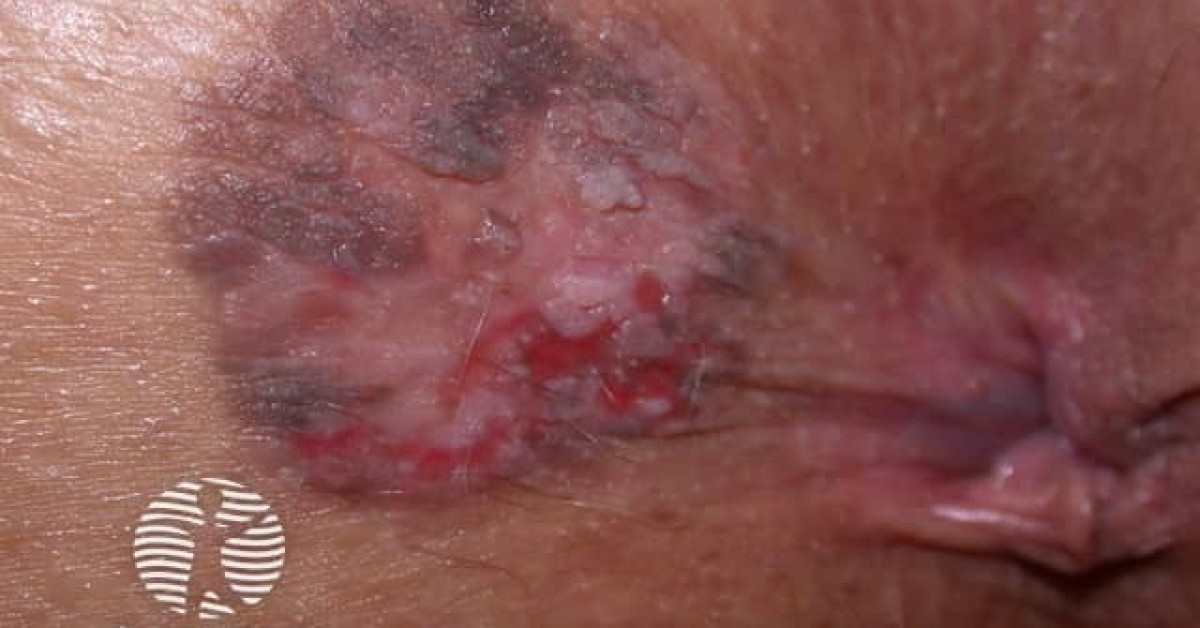
Terminology (LAST 2012)
- LSIL (AIN1) — basal-third atypia; usually transient HPV-related; low progression risk.
- HSIL (AIN2/3) — full-thickness or near-full-thickness atypia; the true precursor of invasive anal SCC; treatment indicated.
- p16 immunohistochemistry strongly diffuse positive supports HSIL classification of borderline cases.
- "Perianal Bowen's disease" describes HSIL on the keratinised perianal skin (outside the anal verge); same biology, same management principles.
Risk groups
- HIV-positive men who have sex with men (MSM) — highest risk; anal HSIL prevalence 30–50%.
- HIV-positive women.
- HIV-negative MSM.
- Women with high-grade cervical / vulval / vaginal intraepithelial neoplasia or invasive cancer.
- Solid-organ transplant recipients.
- Smokers.
- Immunosuppression (autoimmune disease therapy, primary immunodeficiency).
Clinical features
- Most patients are asymptomatic.
- Pruritus, soreness, bleeding, tenesmus or discharge in some.
- Lesions: white (acetowhite after acetic acid), red, pigmented or warty plaques on the anal canal squamocolumnar junction or perianal skin.
- Frequently multifocal in immunocompromised / HIV-positive patients.
- Examine the entire anogenital area (vulva, vagina, cervix, penis, scrotum, perianal) — synchronous lesions common.
Diagnosis
- High-resolution anoscopy (HRA) — the gold standard. After application of acetic acid and Lugol's iodine, the squamocolumnar junction is examined under colposcopic magnification; suspicious lesions are biopsied.
- Anal cytology (cytobrush) — adjunctive screening, similar to cervical cytology; abnormal results trigger HRA.
- HPV typing (high-risk HPV especially HPV-16) supports diagnosis.
- HIV testing if not already known.
- Cervical / vulval examination in women.
Management
- HSIL (AIN2/3): active treatment is preferred over watchful waiting, particularly in HIV-positive patients (ANCHOR trial 2022).
- Topical imiquimod 5% 3 nights/week for 12–16 weeks — 50–60% complete response.
- Topical 5-fluorouracil — alternative.
- Infrared coagulation (IRC) in clinic under HRA guidance.
- Electrocautery, CO₂ laser, cryotherapy.
- Surgical excision for unifocal accessible lesions.
- Combination / sequential approaches for multifocal disease.
- LSIL (AIN1): surveillance only.
- HPV vaccination — primary prevention; emerging evidence for therapeutic / secondary prevention of recurrence post-treatment.
- Discuss with anal dysplasia / colorectal MDT in HIV-positive or recurrent cases.
Surveillance
- HIV-positive MSM and other high-risk groups — annual HRA; lifelong.
- Post-treatment HSIL — 6-monthly HRA for 2 years, then annually.
- Smoking cessation.
- HIV viral suppression and immune reconstitution.
References
- Palefsky JM et al. Treatment of anal high-grade squamous intraepithelial lesions to prevent anal cancer (ANCHOR trial). N Engl J Med; 2022.
- Stier EA et al. International Anal Neoplasia Society guidelines for the practice of high-resolution anoscopy. J Low Genit Tract Dis; 2019.
Spot a correction?
If any clinical statement, citation or link on this page needs updating, please email admin@skinoncology.net with the page name, the proposed correction and the supporting source.