

Atypical fibroxanthoma
AFX
Atypical fibroxanthoma is a low-grade pleomorphic dermal sarcoma with an excellent prognosis when completely excised. It is the superficial counterpart of pleomorphic dermal sarcoma (PDS) — distinction depends on depth of invasion and high-risk features. Sun-exposed scalp and head-and-neck of older patients is the typical presentation.
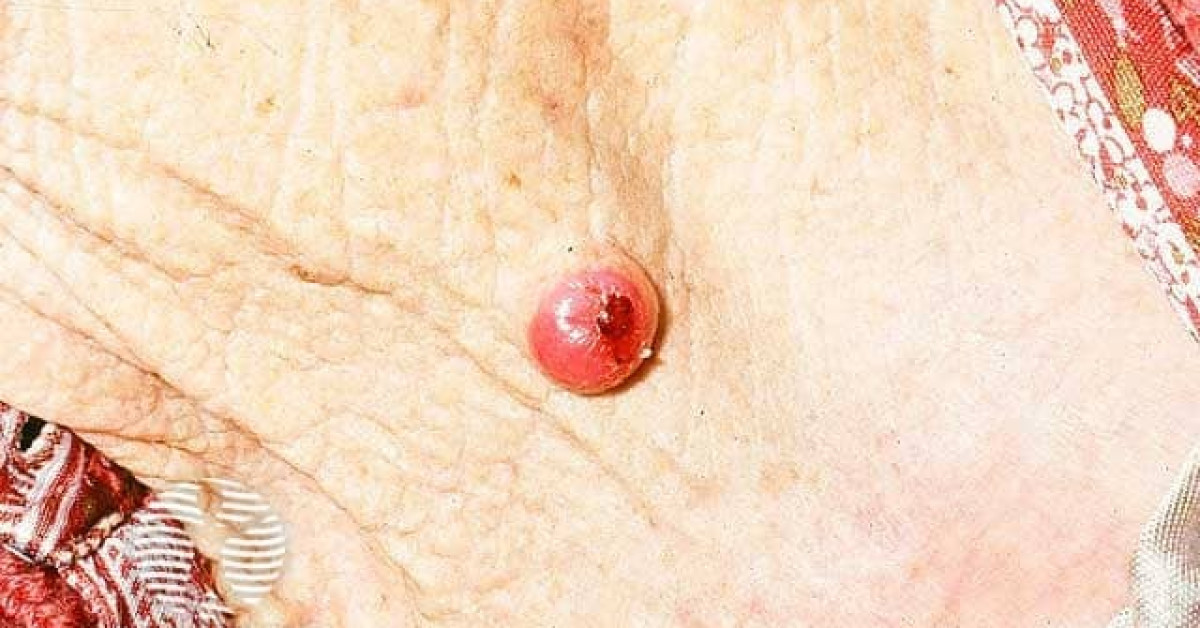
Clinical features
Solitary, rapidly growing red or pink nodule on chronically sun-damaged skin of the scalp, ear or face in older men. Often ulcerated. Differential clinical diagnoses include amelanotic melanoma, cSCC, BCC, pyogenic granuloma, Merkel cell carcinoma.
Diagnosis
Histology: pleomorphic spindled and epithelioid cells with bizarre nuclei and brisk mitoses confined to dermis (AFX) or invading deep into subcutis (PDS). No specific positive marker.
Diagnosis of exclusion — IHC panel
- S100 / SOX10 negative — excludes melanoma.
- Pan-cytokeratin (AE1/AE3, CK5/6) negative — excludes poorly-differentiated cSCC.
- SMA / desmin negative — excludes leiomyosarcoma.
- CD31 / ERG negative — excludes angiosarcoma.
- CD68, CD10, vimentin, procollagen-1 may be positive (non-specific).
AFX vs PDS distinction
PDS is favoured by: invasion of deep subcutaneous fat or below, tumour necrosis, perineural invasion, lymphovascular invasion, large size (≥ 2 cm).
Management
- Mohs micrographic surgery preferred; otherwise wide local excision with 1 cm peripheral margin to fascia.
- For PDS: 2 cm margin where feasible; consider adjuvant radiotherapy for positive margins or high-risk features; baseline cross-sectional imaging.
- Reconstruction: scalp defects often require local flap or skin graft; consider tissue expansion for larger defects.
Follow-up
- AFX: 6 monthly clinical review for 2 years, then annual for 5 years; no routine imaging.
- PDS: clinical review every 3 months in year 1, every 6 months in years 2–5, then annually thereafter; CT chest or cross-sectional imaging according to MDT risk, baseline findings and symptoms.
- Ongoing field surveillance for second primaries on actinically damaged skin.
References
- Soleymani T et al. Atypical fibroxanthoma and pleomorphic dermal sarcoma: updates on classification and management. Dermatol Clin; 2019;37:253–9.
- Beer TW et al. Atypical fibroxanthoma — biological prognosis and incidence of metastasis. Am J Dermatopathol; 2010;32:533–40.
Spot a correction?
If any clinical statement, citation or link on this page needs updating, please email admin@skinoncology.net with the page name, the proposed correction and the supporting source.