

Lichen sclerosus
LS; lichen sclerosus et atrophicus (older); balanitis xerotica obliterans (penile presentation); kraurosis vulvae (vulval; obsolete)
Lichen sclerosus is a chronic, scarring inflammatory dermatosis with a strong predilection for anogenital skin — particularly the vulva, penile foreskin and perianal area — and a smaller proportion of extragenital cases. It produces white, atrophic, sclerotic plaques with itch, soreness, dyspareunia, dysuria and architectural distortion (loss of labia minora, clitoral hood phimosis, urethral meatal stenosis, penile phimosis). Its single greatest oncological significance is the substantially elevated risk of squamous cell carcinoma arising in the affected field — approximately 4–5% lifetime risk for vulval LS and approximately 2–8% for penile LS — particularly the differentiated (non-HPV-driven) form of intraepithelial neoplasia. Effective long-term ultrapotent topical corticosteroid maintenance dramatically reduces this risk, and surveillance is essential.
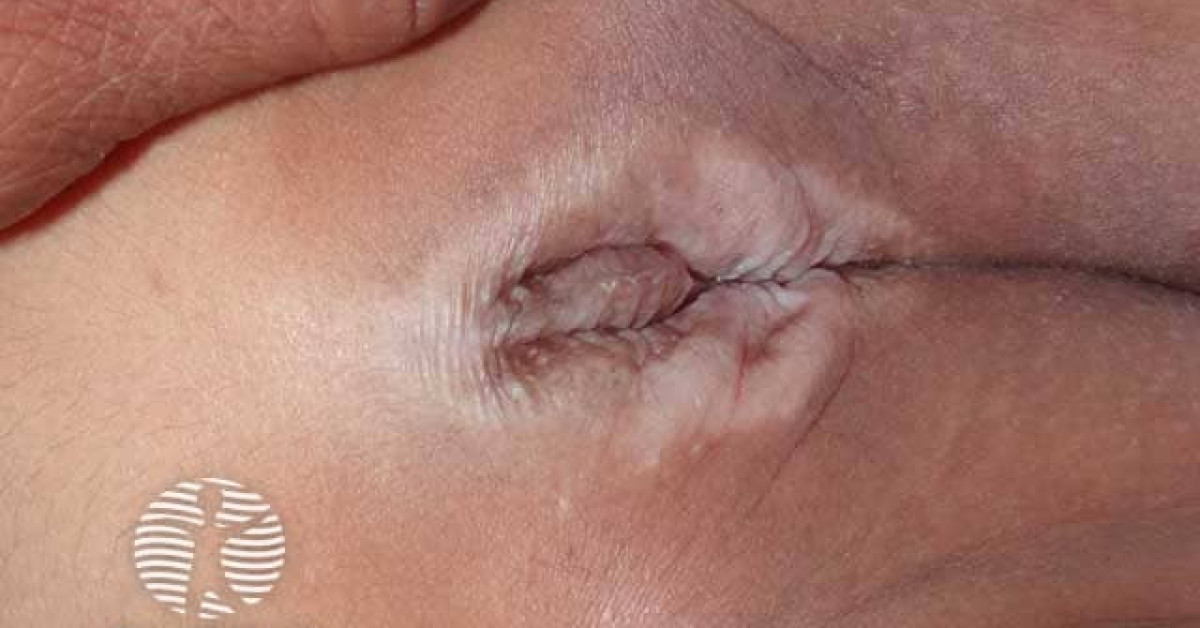
Clinical features
- White, atrophic, "cigarette-paper"-thin, sclerotic plaques with characteristic figure-of-eight (vulvo-perianal) distribution in women.
- In men: white sclerotic plaques on the glans and prepuce; phimosis, meatal stenosis.
- Symptoms: pruritus (often intractable), soreness, dyspareunia, dysuria, splitting / fissuring, bleeding.
- Architectural change: labial fusion, clitoral burying, introital stenosis (women); preputial adhesions, phimosis, meatal narrowing (men).
- Extragenital sites (~10%): trunk, neck, wrists, axillae — usually asymptomatic plaques.
- Bimodal age distribution — pre-pubertal girls and post-menopausal women; men less commonly, mostly middle-aged.
- F:M ~6–10:1.
- Associated autoimmune disease (thyroid, vitiligo, alopecia areata) in 20–30%.
Diagnosis
- Clinical recognition is sufficient in classical cases.
- Punch biopsy when:
- Atypical features.
- Failure to respond to potent topical steroid after 3 months.
- Erosion, ulceration, induration, hyperkeratosis or new lesion — to exclude SCC or vulval / penile intraepithelial neoplasia.
- Histology: hyperkeratosis, epidermal atrophy, basal-cell vacuolation, hyalinised pale subepidermal band of dermal sclerosis, lymphocytic infiltrate beneath the sclerotic band.
- Differential: vulval / penile lichen planus, vitiligo, morphoea, atrophic lichenification, mucous membrane pemphigoid.
Cancer risk
- Vulval SCC — lifetime risk 4–5% in women with LS.
- Penile SCC — lifetime risk approximately 2–8% in men with LS (a major risk factor for non-HPV-related penile SCC).
- Anal SCC — modest increase reported.
- Risk is reduced — though not eliminated — by long-term ultrapotent topical steroid maintenance and tight inflammatory control.
- Differentiated VIN / PeIN (non-HPV-related) is the typical pre-invasive pathway; this is harder to recognise clinically than HPV-driven HSIL because it appears as subtle thickening or erosion within a field of LS.
Management
- First-line: ultrapotent topical corticosteroid (clobetasol propionate 0.05% ointment) — once daily for 4 weeks, then alternate days for 4 weeks, then 1–2 times weekly long-term maintenance.
- Emollients (white soft paraffin) liberally; soap substitutes.
- Topical calcineurin inhibitor (tacrolimus 0.1% or pimecrolimus 1%) as steroid-sparing maintenance.
- Vulval hygiene measures; avoid soaps and irritants.
- Vaginal oestrogen for postmenopausal women with concurrent atrophic vaginitis.
- Penile LS: high-potency topical steroid; circumcision is curative for prepuce-only disease.
- Surgery for architectural complications: division of fused labia, urethral meatotomy, vulvectomy or penile resurfacing for advanced disease (in specialist centres).
- Refer suspicious lesions to vulval / urology MDT.
Surveillance
- Lifelong follow-up — 3–6 monthly initially, then annually with maintenance.
- Biopsy any new erosion, induration or hyperkeratotic plaque.
- Patient self-monitoring with mirror; counsel about cancer warning signs.
- Document architecture changes photographically.
References
- Lewis FM et al. British Association of Dermatologists guidelines for the management of lichen sclerosus. Br J Dermatol; 2018.
- Lee A et al. Long-term management of adult vulvar lichen sclerosus: a prospective cohort study. JAMA Dermatol; 2015.
Spot a correction?
If any clinical statement, citation or link on this page needs updating, please email admin@skinoncology.net with the page name, the proposed correction and the supporting source.