

Necrolytic migratory erythema
NME; glucagonoma syndrome rash; "pseudoglucagonoma syndrome" (when NME occurs without a glucagonoma — chronic liver disease, malabsorption, IBD, zinc deficiency)
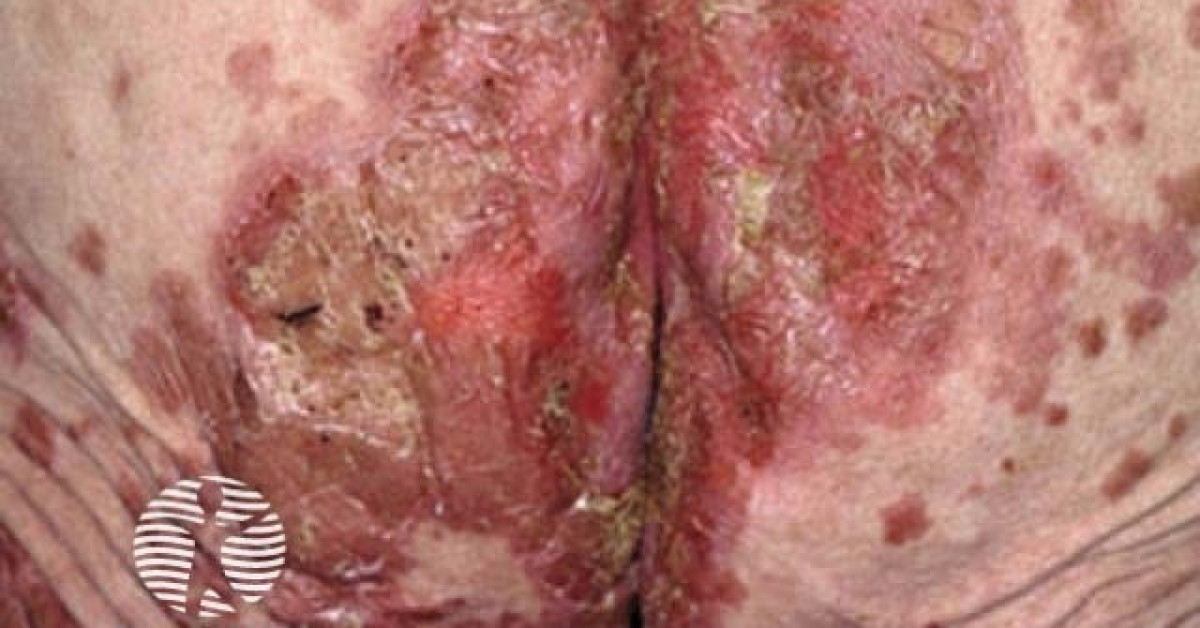
Necrolytic migratory erythema is the pathognomonic cutaneous sign of glucagonoma syndrome — a rare paraneoplastic dermatosis associated with an α-cell islet-cell neuroendocrine tumour of the pancreas (glucagonoma) producing markedly elevated serum glucagon. The classical eruption begins as erythematous patches in the perineum, groin and lower abdomen that evolve through bullae, erosion, crusting, central healing and peripheral expansion to produce migratory annular and serpiginous plaques. Other features of glucagonoma syndrome include diabetes mellitus / impaired glucose tolerance, weight loss, painful glossitis / cheilitis, anaemia, deep vein thrombosis, depression, diarrhoea and the cardinal glucagonoma mnemonic ("4 Ds": dermatitis, diabetes, depression and either deep vein thrombosis or diarrhoea; with glossitis often added as a fifth D). The eruption is one of the few skin signs that, on visual recognition alone, can lead a dermatologist to diagnose a curable pancreatic malignancy. NME may rarely occur without an underlying glucagonoma in chronic liver disease, malabsorption, IBD or zinc deficiency ("pseudoglucagonoma syndrome").
Clinical features
- Symmetrical erythematous patches in the perineum, groin, lower abdomen, perioral region, axillae and acral surfaces.
- Lesions evolve through stages — erythema → flaccid bullae / vesicles → erosion / crusting → central healing with hyperpigmentation → peripheral expansion → annular / serpiginous plaques with the centrally healed area surrounded by an active necrotic edge.
- Migratory — individual lesions resolve in 7–14 days while new lesions appear at the periphery.
- Painful glossitis and cheilitis (red, smooth, fissured tongue and lips).
- Brittle nails, alopecia, paronychia.
- Co-existing weight loss (>5–10 kg), diabetes / impaired glucose tolerance, anaemia, hypoaminoacidaemia.
- "4-D syndrome" — dermatitis, diabetes, deep vein thrombosis, depression.
- Differential — pemphigus foliaceus, pustular psoriasis (von Zumbusch), zinc deficiency (acrodermatitis enteropathica), biotin deficiency, kwashiorkor (essential amino acid deficiency).
Pathogenesis
- Glucagonoma — α-cell islet neuroendocrine tumour of the pancreas, typically in the pancreatic tail; the majority are malignant, often metastatic at diagnosis.
- Pathogenic mechanism — combined hyperglucagonaemia, hypoaminoacidaemia, zinc deficiency and essential fatty acid deficiency disrupts epidermal energy metabolism, causing the necrolytic eruption.
- Pseudoglucagonoma syndrome — same pathway disturbed by chronic liver disease, malabsorption (cystic fibrosis, IBD, coeliac), pancreatitis or zinc deficiency, without an underlying glucagonoma.
Histology
- Subcorneal / superficial intraepidermal clefting with confluent necrosis of the upper third of the epidermis (necrolysis), pallor of the upper Malpighian layer ("pale upper epidermis"), and abrupt transition to underlying viable epidermis.
- Sparse dermal lymphocytic infiltrate.
- Multiple biopsies from active lesion edges may be needed — diagnostic histology often subtle.
- Differential by histology — pemphigus foliaceus (superficial intraepidermal acantholysis, no necrolysis), pellagra (UV-induced epidermal necrosis), zinc deficiency (similar but no glucagon elevation), biotin deficiency.
Workup
- Serum glucagon — markedly elevated (typically >500 pg/mL; often >1000) in glucagonoma; normal in pseudoglucagonoma.
- Fasting glucose, HbA1c.
- FBC (anaemia), albumin, amino acid profile (hypoaminoacidaemia), zinc, biotin, essential fatty acid panel.
- LFT, coagulation.
- CT chest/abdomen/pelvis with pancreatic protocol; endoscopic ultrasound; somatostatin receptor scintigraphy / DOTATATE PET — to identify pancreatic primary and assess for hepatic metastasis.
- Pancreatic neuroendocrine tumour MDT referral.
- If glucagon normal — investigate for pseudoglucagonoma causes (chronic liver disease, malabsorption, IBD, zinc deficiency).
Management
- Glucagonoma — surgical resection of the pancreatic primary (curative if early) plus management of hepatic metastases (resection, embolisation, peptide receptor radionuclide therapy, somatostatin analogues).
- Symptomatic control of NME:
- Somatostatin analogues (octreotide, lanreotide) suppress glucagon secretion and rapidly improve the eruption.
- IV amino acid infusion, zinc and essential fatty acid supplementation.
- Topical corticosteroid for symptomatic lesions; bland emollients.
- Diabetes management; venous thromboprophylaxis (high VTE risk).
- NET MDT — peptide receptor radionuclide therapy with ¹⁷⁷Lu-DOTATATE (NICE TA539) for advanced gastroenteropancreatic NETs.
- Refer to a specialist neuroendocrine tumour service (UK: Royal Free, Christie, ENETS Centres of Excellence).
References
- van Beek AP et al. The glucagonoma syndrome and necrolytic migratory erythema — a clinical review. Eur J Endocrinol; 2004.
- Tolliver S et al. Necrolytic migratory erythema — review. Cutis; 2018.
Spot a correction?
If any clinical statement, citation or link on this page needs updating, please email admin@skinoncology.net with the page name, the proposed correction and the supporting source.